Time blocking helps you decide when a task will happen.
But there is another question that matters just as much:
Will you have the energy to do it then?
A free hour at 9:00 a.m. may be enough to write, design, study, or solve a difficult problem. A free hour at 4:00 p.m. may technically contain the same 60 minutes, but it may be much better suited to email, scheduling, expenses, or other routine work.
The problem is that most planning systems treat every open hour as interchangeable.
They are not.
Energy-based planning means matching the kind of work you need to do with the level of attention you are likely to have. It does not require a complicated productivity system. You simply observe your real patterns, look at the commitments already on your calendar, and use your most useful hours more deliberately.
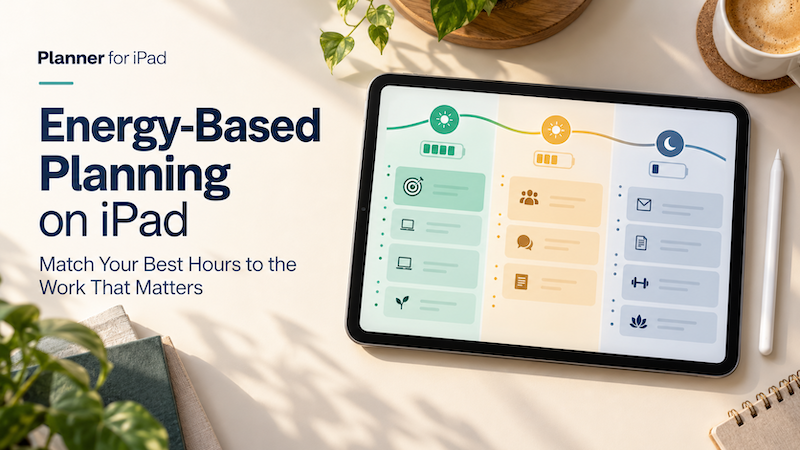
On iPad, this works especially well when your calendar events and handwritten plans can appear together. Your calendar shows what is fixed. Apple Pencil gives you a flexible way to mark focus, fatigue, recovery, and the work that belongs in each part of the day.
This guide explains how to build a simple energy-based planning system with iPad, Apple Pencil, and Planner for iPad.
Why Time Management Alone Is Not Enough
Traditional planning asks questions such as:
- What do I need to do?
- How long will it take?
- When is the deadline?
- Where can it fit?
These are important questions. But they can still produce a plan that looks realistic on the page and fails in practice.
Imagine that you have a two-hour opening after three meetings. You place your most difficult task there because the time is available. When the block begins, however, you are mentally tired, still thinking about the meetings, and unable to concentrate.
The schedule had enough time. It did not have the right kind of time.
This is why some tasks remain unfinished even when they have been given a place on the calendar. The problem is not always discipline. Sometimes the task and the energy level are badly matched.
Energy-based planning adds one more question:
What kind of attention will this task require?
Once you begin asking that, the shape of the day becomes easier to understand.
You Do Not Need to Become a Morning Person
Productivity advice often assumes that your best work should happen early in the morning.
That may be true for some people. It is not a universal rule.
You may concentrate best late at night. Your strongest period may begin after lunch. You may have excellent energy in the morning on quiet days but very little after an early commute. If you work shifts, care for children, manage a chronic condition, or have a schedule controlled by clients and meetings, your pattern may change from one day to another.
Do not build an ideal routine based on someone else’s day.
The goal is to discover when you can do different kinds of work under the conditions that actually exist in your life.
That requires observation, not aspiration.
Start with Three Energy Levels
You do not need to score your energy from one to ten or track every hour in a spreadsheet.
Begin with three simple levels.
High energy
This is when you can concentrate, make decisions, tolerate difficulty, and stay with a problem.
Good tasks for high-energy periods may include:
- Writing
- Designing
- Programming
- Studying difficult material
- Strategic planning
- Preparing an important presentation
- Making a complex decision
- Beginning work you have been avoiding
High-energy time is usually limited. Protect it from work that can be done later with less attention.
Medium energy
This is when you can work reliably but may not want to begin the most demanding task of the week.
Medium-energy tasks may include:
- Meetings
- Reviewing a draft
- Editing
- Planning the next day
- Organizing project materials
- Routine client work
- Following an established process
- Preparing for an appointment
This level is useful for work that requires attention but not deep concentration.
Low energy
Low energy does not mean useless time.
It is often a good period for clear, limited, routine actions such as:
- Scheduling
- Filing
- Expenses
- Simple forms
- Updating records
- Ordering supplies
- Tidying a workspace
- Reviewing tomorrow’s calendar
The mistake is not having low energy. The mistake is placing your most cognitively demanding work inside a period when you already know concentration will be difficult.
Observe Your Real Pattern for One Week
Before rebuilding your schedule, spend one week noticing what already happens.
At three or four points each day, write a quick mark in your planner:
- H for high energy
- M for medium energy
- L for low energy
You can also use colors:
- Green for focused
- Yellow for steady
- Gray for tired
Keep the system simple. The purpose is not to create a beautiful tracker. It is to notice patterns.
At the end of the week, look back and ask:
- When did concentration come easily?
- When did I feel slower?
- Which meetings left me tired?
- Did lunch, travel, or exercise change my attention?
- Which days were different from the others?
- When did I repeatedly avoid difficult work?
- Was I actually tired, or was the task unclear?
One week will not reveal a permanent biological truth. It will give you a useful first draft.
Separate Energy Problems from Task Problems
Not every postponed task was scheduled at the wrong time.
Sometimes the task itself is too vague.
For example:
- “Work on website” does not have a clear starting point.
- “Plan launch” contains several decisions.
- “Study” does not say what material to open.
- “Prepare presentation” may hide research, writing, design, and rehearsal.
A vague task can feel impossible even during your best hours.
Before blaming your energy, make the action smaller and more specific:
- Draft the homepage headline
- Choose three launch priorities
- Read chapter four and mark key terms
- Outline five presentation slides
Energy-based planning works best when the task is clear enough to begin.
Start with Fixed Calendar Events
Your energy pattern does not exist separately from your real schedule.
Meetings, classes, appointments, school pickups, travel, and family commitments may already occupy your preferred focus hours. You cannot always move them.
Begin by opening the weekly view and looking at the events already on your calendar.
These are the fixed points.
Then examine the open periods around them. Instead of seeing only duration, consider the likely quality of each block.
For example:
- Monday, 8:30–10:30: open, quiet, high energy
- Monday, 1:00–2:00: open after lunch, medium energy
- Monday, 3:30–4:30: open after two meetings, low energy
All three periods are available. They should not necessarily receive the same kind of work.
Place the difficult project in the first block, a review task in the second, and administrative work in the third.
This is not about optimizing every minute. It is about avoiding obvious mismatches.
Use Apple Pencil to Mark Energy Zones
A digital calendar is excellent for confirmed events. It is less natural for uncertain, personal information such as anticipated energy.
You probably do not want to create formal calendar events called “medium energy” or “possible afternoon slump.”
Handwriting gives you a lighter planning layer.
With Apple Pencil, you can:
- Shade your best focus period lightly
- Draw a border around protected deep-work time
- Add a small battery symbol beside a block
- Write H, M, or L in the margin
- Use one color for demanding work and another for routine work
- Add a recovery mark after a difficult meeting
- Draw an arrow when a task needs to move
The marks can remain provisional. If the day changes, cross them out, erase them, or redraw them.
Your calendar remains the source of truth for appointments. Your handwritten layer records your current understanding of how the day may feel.
Match Tasks to Energy Before Filling the Schedule
When planning the week, sort important tasks by the kind of attention they require.
You might create three short lists:
Deep work
- Draft project proposal
- Design onboarding flow
- Study two difficult chapters
Steady work
- Review analytics
- Edit presentation
- Prepare meeting agenda
Light work
- Reply to routine emails
- Submit expenses
- Organize files
Now place the categories into suitable periods.
Do not begin by putting the easiest tasks into the first available spaces. Easy tasks create quick progress, but they can consume the part of the day when you were capable of doing something more important.
Reserve your best realistic block for the work that benefits most from it.
Then use medium- and low-energy periods for tasks that still move life forward without requiring your sharpest attention.
Plan Recovery, Not Just Work
Energy-based planning is not only about extracting more work from the day.
It should also make the plan less exhausting.
Some activities have an energy cost beyond their duration. A 30-minute difficult conversation may affect the following hour. Two consecutive video calls may leave you less able to write than one longer meeting. Travel may turn an apparently open afternoon into a low-attention period.
Add recovery space after demanding events when possible.
Recovery might mean:
- A short walk
- Lunch away from the screen
- Ten minutes to clear meeting notes
- A quiet transition before deep work
- An unassigned block after travel
- Ending the day without adding one more task
This space is not a reward you earn after completing everything. It is part of what makes the rest of the schedule usable.
Use Weekly and Daily Views Together
Energy patterns are easier to see across a week than inside a single day.
The weekly view helps you notice:
- Which mornings remain open
- Which days are dominated by meetings
- Where demanding tasks are clustered
- Whether you have protected any recovery time
- Which day contains the best block for important work
The daily view helps you respond to reality.
You may have expected high energy on Tuesday morning and slept badly instead. A meeting may be added. A task may require more attention than expected.
Use the weekly view to create the broad plan. Use the daily view to adjust it.
This keeps energy-based planning flexible. You are making an informed prediction, not signing a contract with your future self.
What to Do When You Cannot Control Your Best Hours
Sometimes your most focused period belongs to your employer, your classes, your customers, or your family.
Energy-based planning is still useful.
If you cannot protect the ideal two-hour block, look for a smaller opportunity:
- Use 30 focused minutes before the first meeting
- Do the hardest part of a task, not the entire task
- Prepare the environment the night before
- Move routine work away from the limited focus time
- Reduce interruptions during the block you do have
- Split a demanding project across several good periods
The goal is not to create a perfect schedule. It is to improve the match between work and attention within the choices available to you.
Even one well-placed task can change the day.
Common Energy-Planning Mistakes
Assuming the pattern never changes
Sleep, health, workload, seasons, travel, and family life all affect energy. Review the pattern rather than turning it into a rigid identity.
Labeling an entire day as unproductive
A low-energy afternoon may still be useful for routine work. Match the task instead of judging the day.
Scheduling too much deep work
Three open hours do not automatically equal three hours of sustained concentration. Begin with a realistic focus block and leave room to stop.
Using your best hours for inbox work
Email is easy to start because it tells you what to do. Important work often requires you to decide. If possible, protect some high-energy time before opening the inbox.
Ignoring transitions
A blank space immediately after a demanding event may not be a true focus block. Allow time to reset.
Treating tiredness as a moral failure
The purpose of the system is to make better plans, not to criticize yourself more efficiently.
A Simple One-Week Experiment
Try this process for seven days.
Day 1: Predict
Look at the week and mark the periods when you expect high, medium, and low energy.
Days 1–7: Observe
Add a quick H, M, or L during the day. Note any major reason the prediction was wrong.
Each evening: Adjust
Move tomorrow’s demanding task if it is placed inside an obviously poor block.
End of week: Review
Compare the prediction with what happened.
Ask:
- Which pattern appeared more than once?
- Which high-energy period should I protect next week?
- Which task belongs in a different part of the day?
- Where do I need recovery space?
Choose only one or two changes for the following week.
A useful system should become clearer over time, not more complicated.
How Planner for iPad Supports Energy-Based Planning
Planner for iPad combines calendar visibility with flexible Apple Pencil handwriting.
Calendar events can appear directly on planner pages, including events from calendar accounts connected to your iPad. You can see the commitments that already shape the day, then add energy zones, focus blocks, task categories, buffer space, and changes by hand.
Daily views help you adjust the current plan. Weekly views help you find the best available periods for demanding work. Monthly and yearly views provide broader context for deadlines and busy seasons.
Planner for iPad also works alongside Apple Reminders, so tasks and deadlines can remain in a reliable digital system while handwriting is used for the decision that matters now:
What should I do with the attention I actually have?
If you are already using time blocking, energy-based planning is a useful next step. The guide How to Time Block on iPad with Apple Pencil and Calendar explains how to place work into the time available. Energy-based planning helps you decide which work belongs in which block.
Plan for a Human Day
A calendar can show that an hour is open.
It cannot tell you whether that hour will be focused, interrupted, tired, creative, anxious, or calm.
That is where handwritten planning becomes useful.
Your calendar provides the structure. Your task list provides the possibilities. Your own observations provide the missing context.
Begin with one week. Notice when difficult work feels easier. Notice what drains you. Protect one good block and move one routine task somewhere less valuable.
You do not need to optimize every hour.
You only need to stop pretending that every hour is the same.