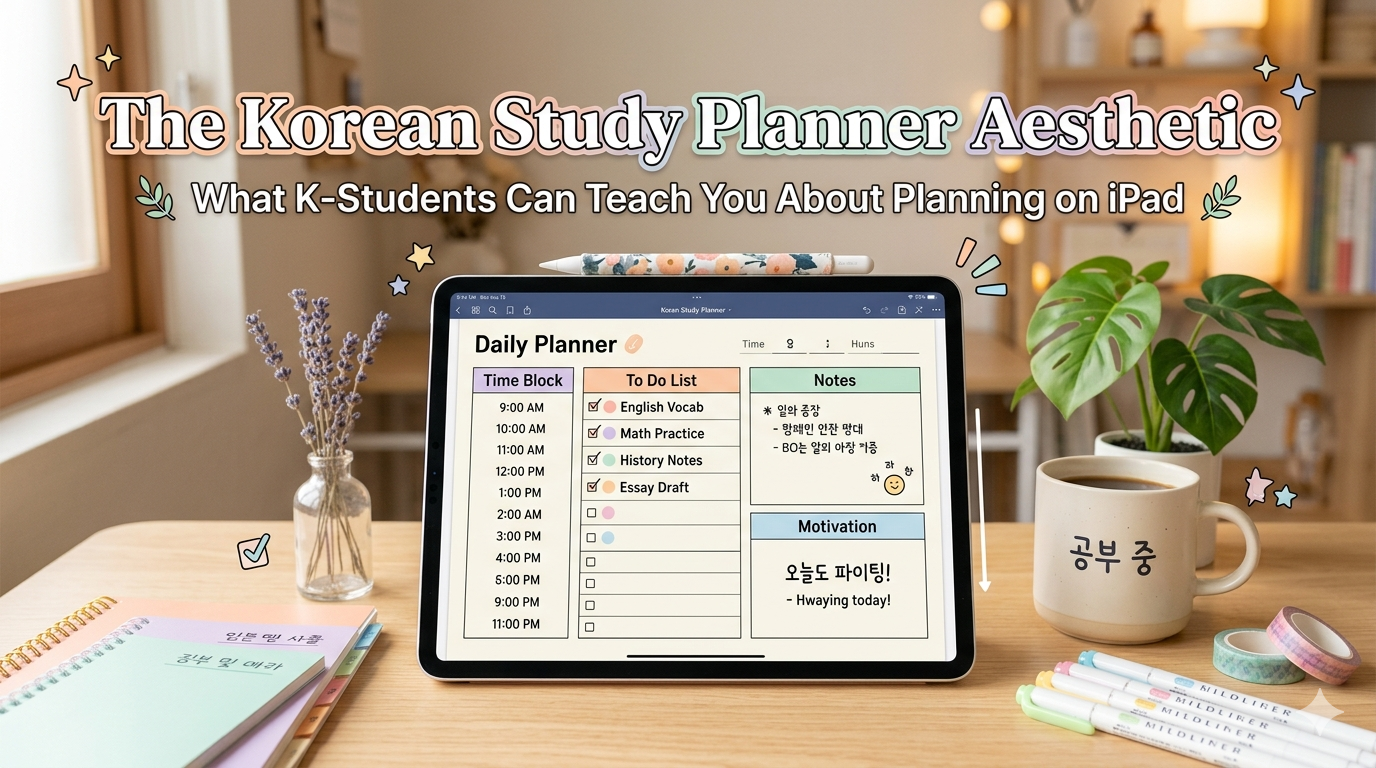
In Korea, planning isn’t decoration. It’s survival — and somehow, that pressure produced the most beautiful study aesthetic in the world.
If you’ve spent any time on YouTube, TikTok, or studygram in the last few years, you’ve seen it. A clean desk shot. A stopwatch in the corner of the screen ticking past the hour mark. A planner open to a grid filled out in precise, color-coded handwriting. Muted background music, maybe rain sounds. No face, no talking — just a hand writing, a page being turned, a timer counting up.
This is the Korean study aesthetic, and it took over the global “study with me” genre almost entirely. What started as a way for Korean high school students to document their exam prep became one of the most influential visual languages in modern productivity culture — copied in Indonesia, the Philippines, Brazil, the US, and everywhere in between.
But strip away the aesthetic, and what you find underneath is a planning system shaped by one of the most intense academic environments on Earth. If you’re trying to build a planning habit on iPad — whether you’re a student, a language learner, or just someone who wants to plan better — there’s a lot to learn here. Not from the decoration. From the structure underneath.
The Pressure That Created the Aesthetic
To understand Korean study planning, you have to understand the Suneung.
The Suneung (수능) — officially the College Scholastic Ability Test — is an 8 to 9-hour exam that takes place on one Thursday every November. It’s not quite an exam in the way the SAT is an exam. It’s closer to a national event. The stock market opens late. Flights are grounded during the English listening section to reduce noise. Police escort late students to testing sites on motorcycles. For the students taking it, the result largely determines which university they attend, which in turn shapes career prospects and social trajectory for decades afterward.
By most accounts, Korean high school students preparing for Suneung study 12 to 16 hours a day. The National Youth Policy Institute has reported Korean youth aged 15–24 averaging close to 50 hours of study per week, well above the OECD average. On weekdays, students are in school or at cram schools (학원, hagwon) from early morning until late at night. Many continue at 독서실 (dokseosil, study rooms) until midnight or later.
This is the environment that produced the study planner culture. Not aesthetics-first. Aesthetics as a side effect of a system designed to track, measure, and squeeze productivity out of impossibly long days.
The Core Idea: Net Study Time (순공부시간)
The single most important concept in Korean study planning is 순공부시간 (sun-gongbu-sigan) — “net study time.” It’s the number of minutes you spent actually focused on studying, not counting the time you were at your desk staring into space, scrolling your phone, or walking to the bathroom.
This is why Korean students are famous for their stopwatches. Not timers counting down to a break, but stopwatches counting up, tracking the total minutes of real focused work across the day. You start it when you begin studying. You stop it when you get distracted. You stop it when you take a break. At the end of the day, the number on the stopwatch is a much more honest picture of your day than “I studied for 10 hours.”
Most serious Korean study planners have a column or a bar chart at the bottom of each daily page where you log this number. The goal isn’t usually some heroic figure. The goal is honesty — to see the gap between the time you spent near your books and the time you actually spent with them.
This is the part of the Korean system that translates anywhere, to anyone. You don’t have to be a 수험생 (suheomsaeng, exam candidate) to benefit from it. Most of us overestimate how much we actually work, read, or create on a given day by a factor of two or three. A stopwatch closes that gap.
The Planner Page, Deconstructed
A typical Korean daily study planner page, whether paper or digital, tends to have five things on it:
A subject grid with time estimates. Not “math” as a single block, but math broken into problem sets, concept review, and mock exam sections, each with a target duration. Students plan the day the night before, allocating time like a budget.
A timeline column. Usually a vertical strip down one side of the page marked in hour or half-hour increments, where students fill in what they actually did. Planned vs. actual. It’s time blocking in its most unforgiving form — you can see your own drift at a glance.
A net study time tracker. The stopwatch total, often visualized as a bar filling up across the bottom of the page. Many Korean students hit 8, 10, or 12 hours of net study time on weekends.
A concept log. A small section for “things I learned today” or “concepts I got wrong” — feedback, not just input. The best Korean planner layouts treat each day as a tiny experiment.
A mood or energy tracker. One word, a small emoji, a simple 1–5 score. Korean study culture takes burnout seriously in practice even when its culture pretends not to. Tracking how you feel is how you catch yourself before you crack.
Notice what’s not there. There’s no sprawling bullet journal setup. No elaborate habit tracker octopus spread. No motivational quote on every page. Korean study planners are dense, functional, and almost clinical in their focus on inputs and outputs. The beauty comes from the precision, not from the decoration layered on top.
The Aesthetic Brands Powering the Look
The Korean stationery industry has a distinctive design language that shows up across planner brands. Think ICONIC, Dasha, AHZOA, Index, and countless smaller brands that sell on Kakao shops, Naver Smart Store, and increasingly, Amazon and Etsy to an international audience.
What they share: muted, dusty color palettes — soft sage, cream, pale blue, dusty rose. Generous use of white space. Grid paper or dotted paper that disappears into the background. Simple sans-serif Korean typography mixed with small English accents. A tendency to include washi tape, masking stickers, and small memo pads as accessories rather than the focus.
The effect is that a finished page looks clean but lived-in. Not a scrapbook. Not a sterile template. A quiet, workable surface with just enough warmth to make you want to open it tomorrow.
This is where the Korean aesthetic diverges from the maximalist bullet journaling style that dominates Western Instagram — and where it overlaps, interestingly, with Japanese techo culture. Both cultures treat the planner as a tool that happens to be beautiful, not a craft project that happens to be organized.
The Studygram and “Study With Me” Explosion
Around 2018, Korean university students and 수험생 began posting long, silent videos of themselves studying to YouTube. No face cam, no voice, just a static shot of a desk, a hand, a stopwatch, and sometimes lofi music or rain. These were called study with me videos, and they went viral.
The premise is simple: studying feels lonely. Studying alongside someone, even a stranger in a video, feels less lonely. Korean students had always studied together in 독서실 and cafés partly for this reason. The YouTube version just scaled it globally.
The format exploded because it solved a real problem — accountability and focus — with almost zero production cost. By 2020, “study with me” was one of the most searched study-related queries in the world, and the most popular channels were almost entirely Korean or Korean-style. Creators like The Striver, noraebang, and countless anonymous accounts racked up tens of millions of views, many of them streaming live for hours.
The second-order effect was the spread of the aesthetic. A generation of students in other countries started structuring their own study sessions the Korean way — stopwatch, timed blocks, daily planner page photographed and posted. The studygram hashtag (#공스타그램 in Korean, #studygram internationally) became one of the largest niche communities on Instagram.
What K-Students Teach You About Planning on iPad
If you’re setting up an iPad planner and you want to borrow from this culture, here’s what actually matters:
Start with a timed block layout, not a to-do list. The Korean system assumes your day has a finite number of hours and asks you to allocate them before they get allocated by accident. This is time blocking by another name, and it’s one of the few productivity techniques that survives contact with a real student or professional schedule.
Track net time, not elapsed time. The most powerful thing you can add to any planner — digital or paper — is a running total of how much time you actually worked. On iPad, a simple stopwatch app running in a side window can do this. You’ll be shocked how different the real number is from what you assumed.
Separate plan from actual. The Korean page layout almost always has two columns: what you planned to do, and what you actually did. Not to shame yourself, but to calibrate. Most of us plan days for a version of ourselves that doesn’t exist yet. Tracking actuals teaches you who you really are at your desk.
Keep the decoration subtle. The Korean aesthetic is restrained on purpose. Washi tape, stamps, and stickers are used to break up the page, not to fill it. If your planner setup is taking more than a few minutes per page, you’re building a scrapbook, not a planner. We’ve written before about how to decorate your planner without making it the whole point.
Make the page something you’d open tomorrow. This is the deepest principle hiding in Korean study planners. The page has to feel inviting, not punishing. A ruthless productivity page that looks like a spreadsheet will get avoided by next Wednesday. A page with a little warmth — a stamp, a soft color, a small sticker — gets opened.
The Shadow Side
It would be dishonest to write about Korean study culture without mentioning the cost. The intensity that produced the aesthetic also produced some of the highest student stress and adolescent mental health concerns in the developed world. Critics inside Korea have been raising questions for years about whether the Suneung system is fair, sustainable, or even effective at identifying talent.
The 12-hour study day is not something anyone should copy wholesale. The value of the Korean system, for the rest of us, isn’t the hours — it’s the precision. The willingness to measure honestly. The refusal to confuse activity with progress. The aesthetic discipline of a page that takes your time seriously.
Used at a human scale — one focused hour tracked honestly, one well-planned day, one realistic weekly layout — these principles make almost anyone a better planner.
The Quiet Takeaway
Every planning culture is shaped by what it’s trying to protect against. Japanese techo culture protects a sense of seasonal rhythm and personal reflection. Indian planning traditions protect alignment with cosmic and family time. Bullet journaling protects the user from their own scattered thoughts.
Korean study planning protects against the single most precious thing a student has: the hour. It assumes time is leaking. It builds a page designed to catch the leaks.
You don’t need to be facing a national exam to appreciate that. You just need to have ever looked up at the end of a day and wondered where it went.
At Planner for iPad, we think every planning culture has something to teach. Our app brings the tactile joy of handwriting to iPad with Apple Pencil, stamps, templates, and read-only Apple Calendar sync — a surface quiet enough to hold a Korean-style study page or a Japanese-style techo, depending on who you are today. The best planner isn’t the one with the most features. It’s the one you’ll open tomorrow.