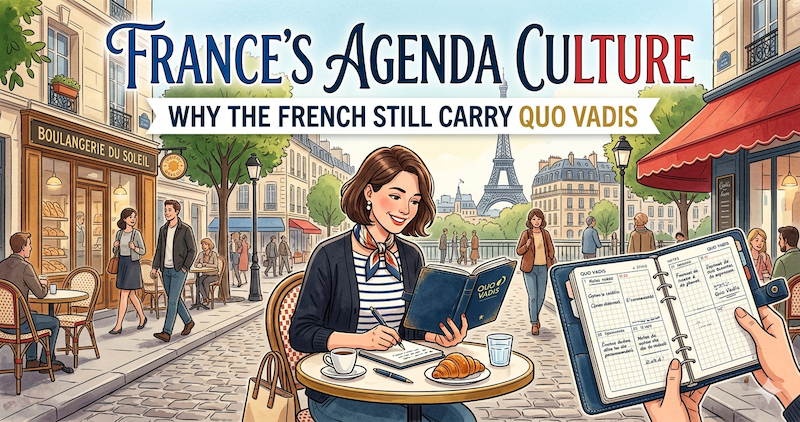
In a country obsessed with the philosophy of time, paper never quite lost the argument.
Walk into a Parisian bookstore in late August — La Hune in Saint-Germain, the labyrinthine Gibert Joseph on Boulevard Saint-Michel, the elegant stationery floor at Le Bon Marché — and you’ll notice something the rest of the world quietly stopped doing about a decade ago. The front tables are stacked with paper agendas. Not as a nostalgic flourish or a hipster reissue, but as a full commercial event. Black leather. Red cloth. Pocket-sized. Desk-sized. School editions for collégiens, professional editions for cadres, weekly spreads, daily spreads, four-language editions printed for a country that still ships its planners across five continents.
Every other developed country has, by now, mostly migrated to digital. Calendars live in iPhones. Tasks live in Notion or Todoist. The paper planner survives as a luxury object or a craft hobby — beautiful, but optional. In France, it survives as something closer to a household item. The same person who runs their consulting practice on a MacBook will, in September, walk into a Cultura and spend forty-five minutes choosing the right agenda for the year ahead. Often, it’s a Quo Vadis. And often, it’s the same one they’ve been buying since they were a teenager.
There’s a reason for this. Several reasons, actually — and they tell you something interesting about how the French relate to time, to paper, and to the small daily rituals that hold a life together.
A Doctor in Marseille Who Couldn’t Find the Right Notebook
The story starts in 1952, in a Marseille medical practice. Dr. Francis Georges Beltrami was a general practitioner running a dispensaire — essentially a community clinic — and he was frustrated. The appointment books available to him at the time all followed the same format: one day per page. Open the book in the morning, and you saw Monday. To see Tuesday, you turned the page. To plan your week, you had to flip back and forth, holding the structure of your time in your head while the book showed you only one slice of it at a time.
Beltrami did what frustrated people sometimes do: he made his own. On a blank notebook, using an ink pad and a hand-cut stamp, he laid out the entire week across two facing pages — Monday through Saturday on a grid, structured by hours and action slots. Sunday off, because France. The whole week, visible in a single glance.
This was such a revelation to him that he closed his medical practice, patented the design, and in 1954 founded Éditions Quo Vadis in Marseille to publish his invention. The format had a name: Agenda Planing® — note the missing ‘n’ in the trademark, a quirk of mid-century French commercial typography. The first product was called the Ministre, and within a year it had spawned the larger Président (21 × 27 cm) and, in 1960, the pocket-sized Affaires (10 × 15 cm).
Then came the moment that, even today, almost nobody outside France knows about. In 1962, the Louvre held an exhibition called Arts et Industries — a curated show of objects deemed to define the design language of the twentieth century. The Quo Vadis Agenda Planing® was selected. It was displayed alongside the Citroën DS and the IBM Selectric typewriter, and it received an honorary prize naming it one of the great industrial products of the era.
Think about that for a moment. The Louvre — the institution that houses the Mona Lisa and the Venus de Milo — decided that a weekly planner belonged in the same conversation as the most beautiful car ever made and the typewriter that defined modern office work. That kind of institutional recognition is part of what shaped the place agendas hold in French life. They were never just stationery. They were treated as design.
In 1966, Quo Vadis released its planners in English, German, Italian, and Spanish, and began exporting to the rest of the world. The same year, Coca-Cola commissioned its first corporate-gift edition. The little Marseille publishing house had become an international brand without ever losing its French identity — the kind of trajectory that, in France, doesn’t surprise anyone.
The Invention That Defined a Century — Agenda Planing®
The Agenda Planing® format looks obvious now. A weekly spread, with the days laid out horizontally or vertically across two pages, hours running down one axis, room for notes along the side. Almost every paper planner you can buy today — Hobonichi Weeks, Moleskine Weekly, Leuchtturm1917 Weekly, the entire bullet journal weekly log tradition — descends from this layout or a sibling of it.
But in 1952, this was a structural innovation. The day-per-page format that Beltrami rejected wasn’t a flaw of one product — it was the industry standard. The whole conceptual leap was the recognition that humans don’t actually live one day at a time. We live in weeks. We make plans that span Tuesday to Friday. We try to balance Monday’s heavy morning against Thursday’s deadline. None of that is visible in a day-per-page book. You can only feel the shape of your week if you can see the whole shape at once.
Beltrami trademarked the grid. Quo Vadis still owns the ® today, more than seventy years later. And the company has built more than eighty different products around variations of it — daily breakdowns for executives, monthly views for parents, academic editions for students that run September-to-September instead of January-to-December, the kind of attention to use case that comes from staying in one specific business for three generations.
What’s striking is that the company has not sprawled into adjacent categories the way most stationery houses do. They make agendas. They make notebooks. They make calendars. They make a few related items — backpacks, pencil cases, paper accessories. That’s essentially the whole catalogue. In an era when every brand seems compelled to extend into apparel, candles, and lifestyle podcasts, Quo Vadis has spent seventy years getting one thing progressively more right.
Why Clairefontaine Paper Matters (And Why You’ve Probably Touched It)
In 1999, Quo Vadis was absorbed into the Exacompta-Clairefontaine group, the dominant force in French paper manufacturing. To anyone who uses a fountain pen, the word Clairefontaine lands with weight. Clairefontaine paper — and its sister brand, the orange-covered Rhodia notepad — is internationally famous in pen-and-ink circles for one specific property: ink doesn’t bleed through it.
This sounds like a small thing. It isn’t. Most paper, including most expensive paper, will let a wet ink line ghost or bleed onto the next page. You discover this the first time you write with a real fountain pen in a Moleskine, and find yourself flipping the page in disappointment. Clairefontaine paper, by contrast, is engineered for l’écriture — for writing, specifically, with the kind of pen the French still take seriously. The paper is brilliantly white, slightly slick to the touch, and behaves as if the ink and the page were designed by the same team. Because, in a sense, they were.
When Quo Vadis joined the Clairefontaine group, the agenda business inherited that paper standard. Open a Quo Vadis Affaires from any year in the last twenty-five years and run your pen across it — fountain pen, rollerball, ballpoint, it almost doesn’t matter — and the writing experience is unmistakable.
This isn’t a small culture point. France is one of the few remaining countries where the physical pleasure of writing on paper is treated as a real consideration in adult life. Stationery shops dedicate aisles to fountain pens. Schoolchildren are taught cursive écriture well into late primary years. Adults still ask for a specific brand of paper, the way someone might ask for a specific olive oil. The Quo Vadis factory in Carquefou, just outside Nantes, produces several million agendas, notebooks, and calendars every year — all under the Origine France Garantie label, certified domestic manufacturing from a country that increasingly treats local production as a quiet form of resistance.
La Rentrée — The National Ritual That Sells Agendas
To understand why agendas remain a household item in France, you have to understand la rentrée.
In most countries, the school year starts and that’s the end of the cultural commentary. In France, la rentrée — literally “the return” — is treated as a second new year. It happens in early September. School resumes, but so does almost everything else: the political season, the theatrical season, the publishing season, the cinema release calendar, the gallery openings, the magazine relaunches. Cultural institutions explicitly time their year around it. Newspapers run rentrée editorials. Television networks debut their fall lineups. The entire country, after a long collective exhale in August, leans forward together.
For families, it begins weeks earlier — usually in mid-August — with the fournitures scolaires, the school supply list. French parents don’t get a casual back-to-school suggestion. They get a detailed, prescriptive list from each teacher: a 24×32 cm grid notebook with a specific cover color, a particular brand of binder, a specific style of pencil case, an agenda scolaire of an exact size. Carrefour, Cultura, Monoprix, Furet du Nord, and dozens of other chains turn over entire sections of their stores to la rentrée throughout August, and the shelves are picked over with a discipline that would surprise anyone used to American back-to-school chaos.
Quo Vadis sits at the center of this annual buying season. Their academic-year Textagenda line — running September to August rather than January to December — anchors the student segment. Adult Parisians, walking past the same back-to-school displays, often quietly pick up a new agenda for themselves. Not because they need one — most of them already have iPhone calendars syncing across devices — but because la rentrée is, emotionally, when a new year starts. January is administrative. September is felt.
There is something specific about this ritual that doesn’t translate to other cultures. Buying a new agenda in France isn’t a productivity decision. It’s closer to the moment in autumn when you take out your wool coats and check which ones still fit. You’re getting ready, materially, to be a slightly different version of yourself for the next twelve months. The agenda is part of how you show up for that.
It’s Not Just Quo Vadis — France’s Wider Paper Ecosystem
Quo Vadis is the most institutionally recognized French agenda brand, but it sits inside a much wider paper culture that’s worth understanding.
Clairefontaine, as mentioned, dominates the school notebook market — the cahier à grands carreaux that nearly every French child has used. Rhodia, with its iconic orange covers and graph-paper interiors, has become a global cult product among writers, designers, and architects. Moleskine is Italian by origin, but France is one of its largest markets, and you’ll see the black notebook in Parisian cafés the way you’d see iPhones elsewhere. Leuchtturm1917 — German — has carved out the bullet journal segment, but again, the French adopted it without resistance.
Beyond notebooks, the writing instruments themselves carry weight. Bic, despite its ubiquity, is a French invention and a point of quiet national pride. Waterman and S.T. Dupont remain reference points for fountain pens. The act of choosing a pen, in France, is closer to choosing a watch than choosing a Sharpie. It says something about you. You are the kind of person who writes with that.
This entire ecosystem reinforces the agenda culture from below. If you grew up writing on Clairefontaine paper with a Waterman fountain pen given to you for your first communion, you don’t simply migrate to typing meeting notes into Notion in your thirties. The muscle memory is too deep. The aesthetic standard you carry is too specific. Paper, for a meaningful slice of the French middle class, remains the medium through which serious thinking happens.
Why Paper Won’t Die in France (And Why Digital Hasn’t Replaced It)
Here’s where the story turns philosophical, because it has to.
In 2018, France passed a national law banning the use of smartphones in schools from primary level through the end of collège. Not “discouraged.” Not “at the teacher’s discretion.” Banned. The country also has the famous droit à la déconnexion — the legal right to disconnect — which protects workers from being expected to respond to work emails outside their official hours. Both of these laws come from the same cultural instinct: a deeply held belief that constant digital availability is corrosive, that human beings are entitled to time that is genuinely theirs, and that institutions have a responsibility to defend that boundary rather than erode it.
Quo Vadis itself, in its corporate mission statement, declares the goal of contributing to “un monde plus sobre, moins connecté et plus heureux” — a more sober, less connected, happier world. This isn’t marketing copy bolted onto a sustainability page. It’s stated, in earnest, as the reason the company exists. They believe paper agendas help people se réapproprier leur temps — reclaim their time — and they say so out loud, without irony, on a corporate website that millions of French consumers see every September.
You can’t extract this from the surrounding culture. France is a country that legally protects long lunch breaks, mandates five weeks of paid vacation, and treats the month of August as functionally closed for non-essential business. The agenda is the material object that supports this rhythm. It doesn’t ping you. It doesn’t sync. It doesn’t surface notifications when you’re trying to think. You write the week ahead in it on Sunday evening, and then you close it, and the week is allowed to be what it is.
This is not a small philosophical position. It’s the deliberate choice of a country that has watched the rest of the developed world hand its attention over to glowing rectangles, and has decided, slowly and without much explanation, to keep some part of itself analog.
What an iPad Planner Can Learn From Quo Vadis
I make a planner app. I should probably say something about that.
I’ve spent close to a decade building Planner for iPad, which means I’ve thought about the design tradeoffs in digital planning longer than I’ve thought about almost anything else. And what I find genuinely instructive about Quo Vadis is not the paper, or the leather, or the fountain-pen-friendly stock. It’s the restraint.
Quo Vadis has had seventy years to add features. They could have added kanban boards. They could have added habit trackers. They could have added pomodoro timers, mood logs, AI-generated reflections, calendar integrations of every conceivable kind. Instead, they made the Agenda Planing® grid slightly better, year after year, and stayed out of the user’s way. The product respects the user’s time. That’s the whole pitch. That’s the only pitch they’ve ever needed.
When I designed Planner for iPad, I tried to take this seriously. The app does a small number of things — Apple Pencil handwriting that feels close to paper, templates that don’t demand a relationship with them, stamps and stickers for the people who want them, and Apple Calendar sync that’s deliberately read-only. Your events from Apple Calendar appear in the planner pages so you can write around them; the app doesn’t push anything back into your calendar. It’s a one-way relationship, and that’s intentional. The planner is a place to think, not another system that’s quietly editing your life behind your back.
I don’t think a digital planner can replace what a Quo Vadis means to someone who has carried one since seconde. The leather, the paper, the smell of new ink on the first day of la rentrée — those aren’t simulatable. But I think a digital planner can honor the same instinct: that the tool should hold your time without colonizing it, that one well-thought-out grid beats fifty features, that the relationship between a person and their planner is supposed to feel a little tender.
If you’re someone who has always loved paper agendas, and you’re considering an iPad planner for the practical reasons — searchability, backups, infinite pages, syncing across devices — the question worth asking isn’t whether the digital version is identical. It isn’t. The question is whether enough of what mattered about the paper version survives the translation. With most planner apps, the answer is no. With a few, including the one I make, I’d argue it’s closer to yes than people expect.
Somewhere in Paris this morning, in a café on a small street in the 11th, someone is opening a Quo Vadis Affaires to the page for this week. They have a café crème on the saucer next to it and a Pilot pen uncapped in their right hand. They’re writing in the small Tuesday column the things they need to do today. They will close the book in a few minutes and walk to the métro, and the book will live in their bag until tomorrow morning, when they’ll open it again at a different café.
This is not an inefficient use of time. It might be the most efficient use of time anyone has figured out. The French, on the evidence of seventy years, seem to think so.
If you enjoyed this, you might also like our pieces on Germany’s Planner Culture and The Korean Study Planner Aesthetic. For more on the philosophy behind keeping planners simple, see You Don’t Need 50 Features in a Planner App and Why Your iPad Planner Doesn’t Need AI.