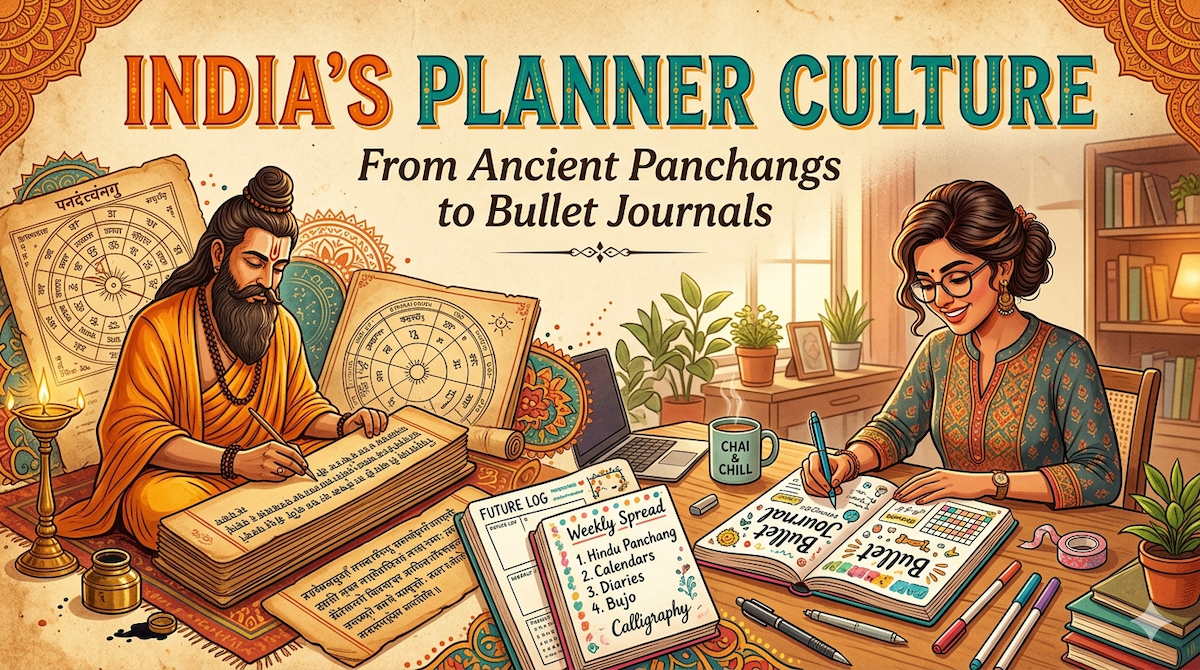
Planning in India didn’t start with Moleskines. It started with the moon.
Long before the modern planner industry discovered habit trackers and weekly spreads, India had already built an entire civilization around the art of organizing time. The Panchang — a Hindu calendar and almanac that tracks five elements of each day — has been guiding when to plant crops, hold weddings, and start new ventures for thousands of years. In a country where over a billion people navigate multiple calendar systems simultaneously — Gregorian, Hindu lunisolar, Islamic Hijri, regional variants like the Bengali or Tamil calendars — the very concept of “planning” carries a weight and complexity that most Western planner enthusiasts never consider.
And yet, India’s planner scene in 2026 is anything but stuck in the past. It’s one of the most rapidly evolving stationery markets in the world, blending ancient traditions of time-reckoning with the global bullet journaling movement, a booming D2C stationery industry, and a generation of young Indians who treat their planners as both productivity tools and creative canvases.
The Panchang: Planning as Cosmic Navigation
To understand Indian planning culture, you have to start with the Panchang. This isn’t a planner in the way Westerners think of one — it’s closer to an almanac that maps the intersection of astronomical phenomena and daily life. The five elements it tracks (pancha meaning five, anga meaning limb) are the lunar day (tithi), the weekday (vara), the constellation (nakshatra), the yoga, and the karana. Together, they determine whether a given moment is auspicious or inauspicious for everything from signing a contract to cutting your hair.
This might sound esoteric, but it has practical planning implications that millions of Indians still follow. Want to schedule a wedding? Consult the Panchang for an auspicious muhurta. Starting a business? Same. Even something as mundane as a housewarming party gets cross-referenced against cosmic timing. The Panchang is, in a sense, the world’s oldest planning system — one where “time management” means aligning your actions with the rhythms of the universe rather than just squeezing more tasks into your morning.
What’s fascinating is that India doesn’t have just one Panchang. There are regional variations everywhere — the Telugu calendar follows the amanta system, the Gujarati calendar has its own version, and so on. Walk into any Indian household and you’ll likely find a printed Panchang calendar hanging on the wall, dense with information in the local script, marking festivals, fasting days, and planetary positions. It’s the original wall planner, and it’s been in continuous use for centuries.
The Diary Tradition: Colonial Roots and Everyday Practice
India also has a deep tradition of diary-keeping that blends colonial British habits with homegrown practices. During the British Raj, commercially produced diaries became common among the administrative class — leather-bound books with daily pages, often including ads for local businesses and tables showing multiple calendar systems side by side. A diary from 1866 Calcutta, for instance, might show the Gregorian date alongside Sambat, Fasli, and Hijri calendars on the same page, reflecting the multicultural reality of Indian life.
This diary tradition never really went away. In modern India, the annual diary remains a staple — gifted by corporations during Diwali, handed out at the start of the school year, carried by professionals who still prefer analog over digital. The “diary” in Indian English often means something broader than it does elsewhere — it can refer to a planner, a journal, a notebook, or a personal logbook, depending on context. When an Indian professional says “let me check my diary,” they might be reaching for a dated corporate planner or a simple notebook where they’ve handwritten their schedule.
There’s also a tradition of diary-writing as personal practice. Some Indians maintain diaries for decades — daily records of weather, health, social engagements, and reflections that become family archives. The practice carries a certain cultural respect, associated with discipline, self-awareness, and the kind of long-term thinking that aligns well with Indian philosophical traditions.
The New Wave: India’s D2C Planner Boom
Fast forward to 2026, and India’s planner market looks completely different from what it did even five years ago. The broader Indian stationery market is valued at around $2.5 billion and growing at roughly 8% annually. Within that, planners and journals have gone from an afterthought to a buzzing category, driven by D2C (direct-to-consumer) brands that understand what Indian consumers actually want.
Factor Notes, launched in 2018 by two brothers in Kochi, is a good example. They saw that the Indian diary market was crowded with generic products and pivoted to premium, design-forward planners. The brand now has over 3 million customers, products in 4,500+ retail stores across India, UAE, and Africa, and consistently ranks as a best-seller in the planner category. Their success says something important: Indian consumers will pay for quality stationery when the design and functionality are right.
Other brands have carved out their own niches — Doodle with its undated weekly planners and habit trackers, Lauret Blanc with clean softcover formats, SKILLSET with goal-oriented daily planners, and a wave of indie creators selling through Flipkart and Amazon India. The trend is clearly toward planners that do more than just show dates. Indian consumers want goal tracking, habit logging, wellness check-ins, and layouts that help them manage the particular chaos of Indian professional life — where personal and work calendars overlap with festival seasons, family obligations, and the juggle of multiple commitments.
Bullet Journaling in India: A Growing Creative Community
Perhaps the most interesting development is the growth of bullet journaling in India. A vibrant community of Indian BuJo artists has emerged on Instagram, bringing their own aesthetic sensibilities to a practice that originated in New York.
Indian bullet journalers tend to bring a distinctive visual warmth to their spreads — rich color palettes, handmade collage elements, washi tape layering, and doodle styles that draw from Indian design traditions without being explicitly “ethnic” about it. Some, like Tanushree Journals, even take custom orders to create bespoke bullet journals for people who want beautiful layouts but don’t have the time or confidence to build their own. Others, like Journal Bambie (Shruti), are known for their cozy, 3D-textured spreads that use a mix of stamps, stickers, and hand-lettering.
The bullet journaling community in India skews young — mostly women in their teens and twenties — and uses the practice as a blend of productivity tool and creative outlet. This mirrors the global BuJo movement, but with an Indian twist: the trackers and layouts often reflect distinctly Indian concerns. You’ll see pages dedicated to tracking JEE or NEET exam preparation, managing the social calendar around Diwali or Navratri, or planning family events with the kind of multi-generational coordination that’s uniquely South Asian.
What India’s Planner Culture Tells Us
India’s planning culture is interesting precisely because it refuses to be one thing. It’s the grandmother consulting the Panchang for an auspicious wedding date and the 20-year-old in Bangalore decorating her bullet journal with pastel washi tape. It’s the corporate professional who still swears by a leather-bound diary and the D2C startup founder who tracks OKRs in a Factor Notes planner. It’s traditional and modern, analog and increasingly hybrid, deeply spiritual and ruthlessly practical — often all at once.
For those of us who think about planning and productivity tools, India is a reminder that the impulse to organize time is universal, but the forms it takes are radically local. The Panchang and the bullet journal serve the same fundamental human need — to impose some order on the chaos of life — but they come at it from entirely different cosmologies. One says: align yourself with the universe’s rhythms. The other says: build your own system from scratch.
Both are valid. Both work. And both remind us that the best planning system is the one that fits how you actually live.
At Planner for iPad, we’re fascinated by how planning cultures differ around the world. Our app brings the tactile joy of handwriting to the iPad with Apple Pencil, read-only Apple Calendar sync, stamps, and templates — a digital surface that respects analog instincts. Whether your planning tradition starts with the stars or a blank page, we think the best tool is one that gets out of your way and lets you plan the way you think.