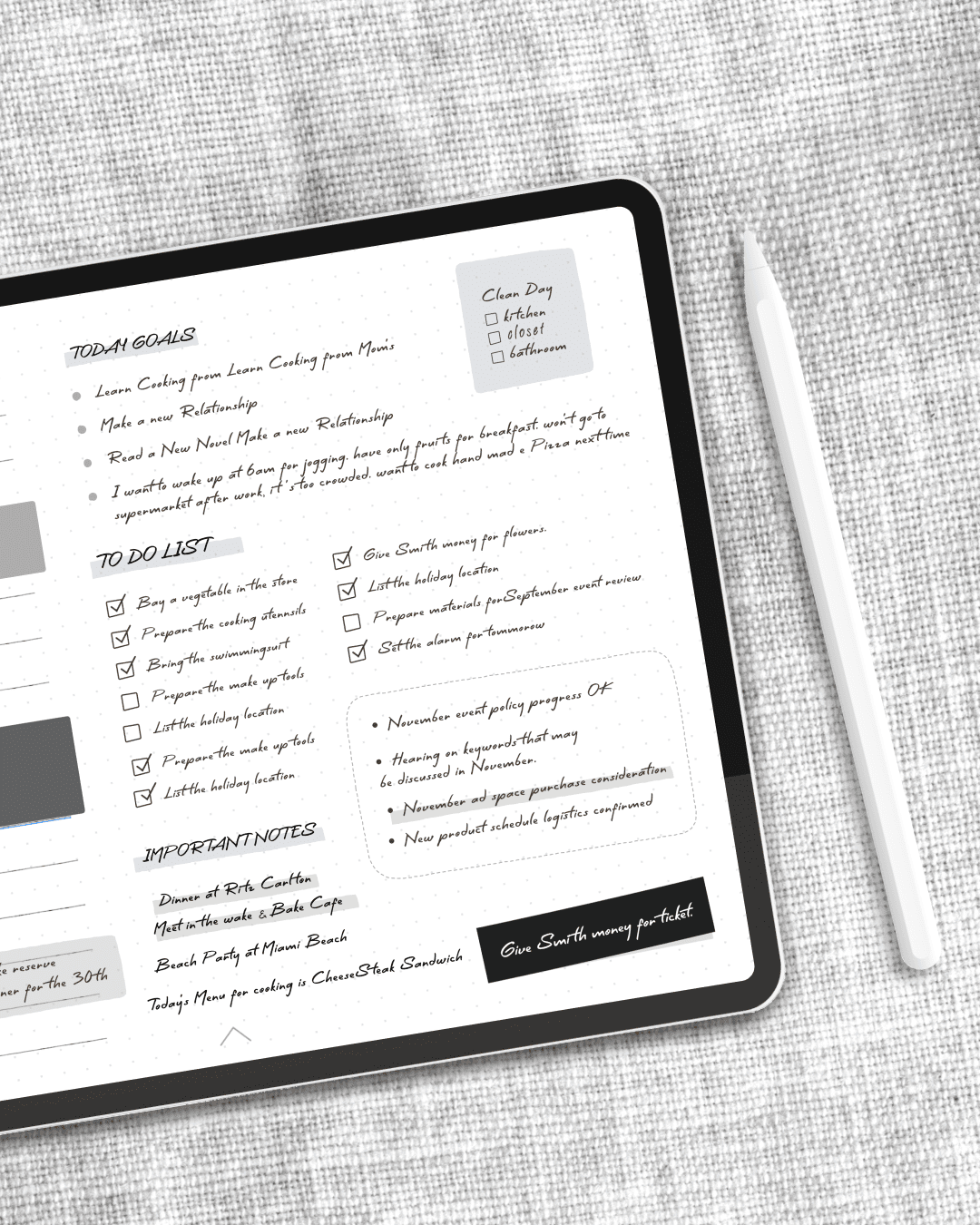
Why a glass screen can feel more like paper than you’d ever expect.
There is a particular kind of silence that comes when you open a blank page. Not the silence of absence — but the silence of possibility. A held breath before the first word. A pause before the pen touches down.
For years, that silence lived inside paper planners. Leather-bound, thread-stitched, chosen carefully at the start of every January. We carried them like promises we made to ourselves. This year, I will be organized. This year, I will remember. This year, I will show up for my own life.
But paper, for all its warmth, has a quiet limitation: it lives in one tense. What is written stays written. What is scheduled stays scheduled. The ink does not bend with us when our lives do.
And our lives always bend.
The First Touch
The first time you write on an iPad with a stylus, something surprising happens. You expect cold. You expect distance — the clinical glow of a screen standing between you and your thoughts.
Instead, you find friction. Resistance. The faint, satisfying drag of tip against glass that feels less like typing and more like thinking out loud. Your handwriting appears — imperfect, human, unmistakably yours — and suddenly the device disappears. What remains is just you and the page.
This is the secret that no spec sheet will ever tell you: planning on an iPad doesn’t feel like using technology. It feels like writing a letter to your future self.
Time Becomes Liquid
A paper planner treats time like a building — rigid, load-bearing, fixed in place. Tuesday is always between Monday and Wednesday. March never speaks to October.
But on an iPad, time becomes something else. Something liquid. Your calendar syncs — not as a feature, but as a philosophy. The dentist appointment you added on your phone at lunch already lives inside your planner when you sit down in the evening. The meeting your colleague scheduled appears without you lifting a finger.
This is not mere convenience. It is a kind of freedom. The freedom to stop managing your schedule and start living inside it.
When your planner knows what your calendar knows, you are no longer a secretary to your own life. You are the author of it.
The Pen Remembers What We Forget
There is a reason we still reach for pens in an age of keyboards. Handwriting is not just recording — it is processing. Neuroscience has shown us what poets always knew: the hand teaches the mind. When we write by hand, we do not simply store information. We metabolize it.
On an iPad, this ancient act gains a quiet superpower. Your handwritten notes sit alongside synced calendars, digital stickers, color-coded highlights. The analog and the digital do not compete — they complete each other.
Write your morning intention in your own hand. Let the calendar remind you where to be. Stamp a small illustration in the corner because beauty is not frivolous — beauty is how we tell ourselves that this day mattered.
A Thousand Planners in One
One of the small sorrows of paper planners is commitment. Choose a weekly layout, and you abandon the daily view. Choose minimalism, and you lose the space for decoration. Every paper planner is a door that closes other doors.
An iPad planner opens them all.
Templates shift with your needs. One week you plan by the hour; the next, by intention. You add pages, remove them, rearrange the architecture of your days the way you rearrange furniture — not because something is broken, but because you are growing.
This is what planning should be: not a cage of grids and lines, but a living space that grows as you do.
The Japanese Philosophy of Techo
In Japan, a planner is not merely a tool. It is a techo — 手帳 — a companion. The relationship between a person and their techo is intimate, evolving, almost devotional. A techo is decorated, personalized, carried everywhere. It is not where you write your schedule. It is where you write your life.
This philosophy — that planning is a form of self-care, that organization is a creative act — is what the best iPad planners inherit. Not the cold efficiency of productivity software, but the warm intentionality of a book you keep close to your heart.
When you place a sticker on a completed goal, you are not being childish. You are celebrating. When you choose a color for the month, you are not wasting time. You are deciding what this chapter of your life feels like.
The Weight You No Longer Carry
A paper planner for a full year weighs something — not just in grams, but in guilt. The blank pages of February when you fell behind. The crumpled corners of a month you’d rather forget. Paper remembers your absences as loudly as your presence.
An iPad planner is lighter in every sense. Lighter to carry. Lighter on your conscience. You can return to it after weeks away and find no accusation in its pages — only a blank space that says, simply, welcome back.
There is grace in a tool that does not judge. There is kindness in a page that waits.
What We Are Really Doing When We Plan
At its core, planning is not about productivity. Not really. It is about paying attention to the shape of your days. It is about saying: this matters to me. This hour, this task, this small commitment I made to myself.
An iPad — with its glowing screen and quiet stylus — becomes an unexpected partner in this act of attention. It does not replace the warmth of paper. It translates it. It carries the soul of handwriting into a world that syncs, adapts, and never runs out of pages.
And when you close the cover at the end of the day, you are left with the same feeling you once had closing a leather-bound notebook:
Today was mine. And tomorrow is waiting.
Planner for iPad brings the soul of handwriting together with the intelligence of your calendar. Write by hand. Sync with life. Plan like it matters — because it does.