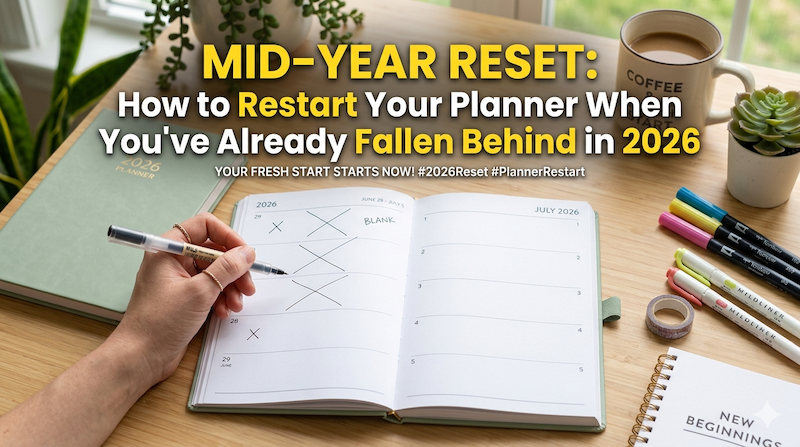
It’s May. The planner you started in January has a few good weeks at the front, a slow fade in February, and a clean white silence after that. Here’s how to actually start again — without the guilt, the fresh-start fantasy, or the productivity sermon.
There’s a specific kind of stillness inside a planner that’s been abandoned in February.
You open it in May, hoping for some flicker of recognition, and what you find is a stranger’s handwriting. January’s goals look weirdly earnest. The first two weeks are color-coded and careful. Then a couple of pages with just dates and meetings. Then nothing.
If you’re reading this, you probably bought a planner in late December or early January with the kind of optimism that only happens when a year is still theoretical. Maybe it was a Hobonichi. Maybe it was a leather Filofax. Maybe it was an iPad and a fresh GoodNotes template you spent two hours customizing. The specifics don’t matter. The shape of the failure is the same.
And right now, in May, the question you’re asking yourself isn’t should I keep planning. It’s is it even worth starting again with five months gone.
The answer is yes. But not for the reasons most articles will give you.
The myth of the fresh start
Every “mid-year reset” article you’ll find online makes a very particular argument: that you can simply decide to start again, with discipline and the right system, and this time it’ll stick. Most of them are written by productivity coaches selling a downloadable PDF.
This isn’t that article. I’m not selling you a reset template, and I’m not going to tell you that consistency is just a mindset. I make a planner app — but the honest truth I’ve learned from years of watching how people actually use planners is that the January-you who failed isn’t a weaker version of the May-you who’s trying again. They’re a different person, planning for a different life.
The person who filled out January’s pages was someone with a fresh haircut, holiday rest in their bones, and no idea what March was going to throw at them. That person made a plan that fit who they were on January 3rd. Of course it didn’t survive the actual year.
The reset isn’t about willpower. It’s about admitting that you now know things in May that you couldn’t have known in January — and that those things should change what you plan for.
What actually happens in the first five months of a year
Before you open any planner — paper or digital — try this. Get a blank piece of paper, or open a blank note on your iPad. Don’t open the planner yet.
Write down what actually happened from January to May.
Not the goals. Not what you planned. What happened. What did your weeks actually look like? What ate your time? Who needed you unexpectedly? What project got bigger than you thought? What got smaller? What did you do that you didn’t plan, that turned out to matter?
This is the most important step in any honest mid-year reset, and almost nobody does it. We jump straight to what should I do for the rest of the year without first looking at what is my year actually shaped like.
When you do this exercise, a few things usually surface:
- One or two goals from January quietly turned out to be wrong. Not failed — wrong. They were goals the January-you set that no longer match what matters.
- Something showed up that wasn’t on the January list at all, and it’s now eating 20% of your attention.
- Some routine you assumed would be foundational (workouts, journaling, reading) didn’t stick — and you can either rebuild it or admit it’s not actually a priority this year.
- A handful of weeks were objectively brutal in ways nobody could have planned for.
This isn’t failure analysis. It’s calibration. You can’t plan the next seven months realistically until you’ve stopped pretending the first five didn’t happen.
The Japanese idea of the second half
There’s a concept in Japan that I find useful here.
The Japanese fiscal year, school year, and most institutional rhythms split at April — but there’s also a strong cultural recognition of the second half of the year starting around July. Companies do kamihanki (上半期, first half) reviews. People talk about shimohanki (下半期, second half) goals. The year isn’t treated as one continuous push from January to December. It’s two halves that get evaluated separately.
This is a much healthier frame than the Western “new year’s resolution” model, which silently treats failure to maintain a January goal as evidence of personal weakness. In the Japanese frame, hitting July means you naturally take stock and start a new half. The first half being uneven doesn’t poison the second.
You’re allowed to do this. May is a perfectly reasonable place to start a shimohanki — your second half — even if the calendar hasn’t officially flipped yet.
Why iPads are forgiving in a way paper isn’t
Here’s something physical planners can’t do.
If you abandoned a paper planner in February, the unused pages are still there, visibly empty, and reopening the planner in May means staring at three months of blank evidence. You can’t really start fresh without buying a new one — which feels wasteful, which is a guilt all its own.
An iPad planner doesn’t have that problem. You can simply start a new section. A new month, a new week, a new spread, without the physical record of failure haunting every page turn. The previous attempt doesn’t disappear — you can still flip back to it — but it doesn’t sit in front of you every time you open the app.
This matters more than people realize. The reason mid-year resets fail on paper is often just shame fatigue. You keep flipping past dead weeks. With an iPad, you don’t have to.
It’s also why I think iPad planning is unusually well-suited to people who’ve historically failed at planning. The medium itself is less punishing.
The actual restart — a 30-minute version
Once you’ve done the calibration exercise above (which is the hard part, honestly), the actual restart is short. Here’s what works for most people:
Open your planner to today’s week. Not next Monday, not the start of the month. Today. The fantasy that you’ll “really start on Monday” is the same fantasy that killed January. The week you’re in now is the week you have.
Write down what’s already on your calendar this week. If you use Apple Calendar, it can sync directly into Planner for iPad — meetings and events show up automatically, so you’re not transcribing. This is the moment where having a planner that talks to your calendar saves you actual minutes of friction.
Write down three things you want to be different by the end of June. Not for the year. For the next six weeks. The unit of a year is too large to plan honestly in May. Six weeks is a unit your brain can actually believe in.
Decide what you’re not doing. This is the step people skip. Look at the goals you set in January and explicitly cross out the ones you’re letting go of. Don’t just stop thinking about them — write not this year next to them. There’s a strange relief in officially releasing a goal instead of dragging it as quiet guilt.
That’s the entire reset. Thirty minutes. The version that takes three hours and involves color-coding is the same impulse that made January collapse — overdesigning the system instead of using it.
Building a system that survives the second half
Resetting once is easy. Not collapsing again in August is the harder problem.
The single biggest thing that separates people who plan consistently from people who don’t isn’t discipline. It’s a weekly checkpoint — fifteen or twenty minutes, every week, where you look at what’s coming and what just happened. Most of the people I know who actually use their planners year-round do some version of this. Sunday evening, Monday morning, or Friday afternoon — the exact day doesn’t matter.
I’ve written about the Sunday reset ritual and how to do a weekly review on iPad elsewhere — they go deeper into the mechanics. The short version: the people who succeed at planning aren’t the ones with elaborate systems. They’re the ones who show up to the planner once a week, briefly, even when they don’t feel like it.
This is the entire secret. The reset only matters if it’s followed by a habit small enough to survive bad weeks.
What about all those unused pages?
If you’re using a paper planner, you have a real decision to make. Some people tear out the blank months. Some people leave them as a kind of monument. Some people start writing on them anyway, dated from today forward, treating the printed dates as a polite suggestion.
If you’re using Planner for iPad — or any digital planner — this isn’t a problem at all. The “pages” you didn’t use don’t take up space, don’t generate guilt, and don’t require ceremony. You just keep going from today.
This is one of the quiet reasons digital planners have an advantage for people who’ve struggled to maintain a paper planner: the medium itself doesn’t punish you for missing time. The cost of starting again is lower, which means people actually do it.
A note on the goal of all this
Most planning advice treats the goal as productivity. Get more done. Hit your numbers. Optimize your week.
That’s not really what mid-year planning is about, in my experience. The actual purpose of opening a planner in May after months away isn’t to claw back lost productivity. It’s to feel like the year is yours again. To stop carrying the quiet weight of having abandoned something. To restore the small daily contact between you and the shape of your own time.
A planner you use is worth more than a planner you used to use, however beautifully designed the unused one was.
If you decide to try Planner for iPad as your second-half tool, I’d be honored. It was built for exactly this kind of person — someone who wants the feel of handwritten planning, the convenience of a calendar that syncs, and an app that doesn’t punish them for falling behind. You can download it on the App Store.
But honestly, the tool matters less than the decision. If you finish reading this and you reach for the paper planner that’s been silent since February, and open it to this week, and write something — that’s the win. The system can be rebuilt from there.
May is a fine month to start again. So is June, July, or any Tuesday afternoon in October. The year doesn’t actually have a beginning. It just has the week you’re in.
Takeya is the developer of Planner for iPad, an iPad planner built around Apple Pencil handwriting, Apple Calendar sync, and the quiet pleasure of planning by hand. He writes about digital planning, productivity, and the cultures that shape how we organize our time.